 AllQRCode
The Ultimate Guide to URL QR Codes: Convert Any Link Instantly
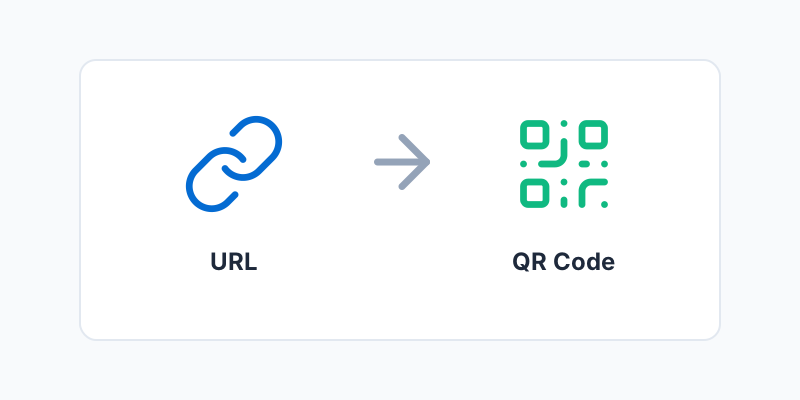
In today’s hyper-connected digital landscape, speed and convenience are paramount. Whether you are a small business owner trying to direct customers to your online storefront, a marketer launching a new campaign, or a teacher sharing resources with students, typing out long, complicated web addresses is a thing of the past. Enter the URL to QR Code Converter—a seamless, instant, and highly efficient way to bridge the physical and digital worlds.
By simply converting a website link into a scannable QR (Quick Response) code, you eliminate user friction. Instead of forcing someone to manually type https://www.yourwebsite.com/special-offer/2026, they can simply point their smartphone camera at the code and be instantly transported to your destination. In this comprehensive guide, we will explore everything you need to know about URL QR codes, how to create them for free on AllQRCode, and best practices for maximizing their effectiveness.
What is a URL QR Code?
A URL QR code is a specific type of two-dimensional barcode that encapsulates a web address (Uniform Resource Locator). When scanned using a modern smartphone camera or a dedicated QR reading app, the device decodes the visual pattern back into the original text string (the link) and automatically prompts the user to open that link in their default web browser.
The technology behind QR codes was originally invented in 1994 by Denso Wave, a Japanese automotive subsidiary, to track vehicles during manufacturing. Because of their high-speed reading capability and massive storage capacity (compared to traditional UPC barcodes), they quickly transcended the industrial sector. Today, they are governed by international ISO standards, making them universally readable by virtually any modern camera.
Why You Should Use a Link to QR Code Generator
- Frictionless User Experience: Typing long URLs on a mobile keyboard is prone to typos. A quick scan ensures 100% accuracy every time.
- Marketing & Print Media: You cannot click a hyperlink on a printed flyer, billboard, or business card. A QR code transforms static offline media into an interactive digital portal.
- Trackable Campaigns: If you use UTM parameters in your URL before converting it, you can easily track exactly how many people scanned your code using Google Analytics.
- Cost-Effective: Generating a static URL QR code using AllQRCode is completely free, and the code never expires.
How to Convert a Link to a QR Code for Free
Creating your custom QR code on AllQRCode is a breeze. We have designed our tool to be incredibly intuitive, requiring absolutely no technical expertise. Follow these simple steps:
- Copy Your Link: Go to the website, YouTube video, or social media profile you want to share, and copy the full URL from the address bar (make sure it includes the
https://part). - Paste the URL: Paste your copied link into the designated input field at the top of this page.
- Customize the Design (Optional): Don't settle for a boring black-and-white square! Use our customization tools to change the colors to match your brand, alter the shape of the data modules (try dots or rounded corners), and select an eye-catching frame.
- Add Your Logo: Upload your company logo or a relevant icon to be placed directly in the center of the QR code. Our generator automatically ensures the code remains scannable even with the logo present.
- Download and Share: Click the download button to save your high-resolution QR code in PNG, SVG, or WEBP format. It is now ready to be printed or shared online!
Best Practices for Printing and Sharing
While generating the code is easy, deploying it effectively requires a bit of strategy. Here are the golden rules for using QR codes in the real world:
1. Always Provide a Call to Action (CTA): Never place a naked QR code on a poster. Users need to know why they are scanning it. Add a short frame or text nearby saying "Scan to view our menu," "Scan for 20% off," or "Scan to RSVP."
2. Size Matters: The minimum recommended size for a printed QR code is 2x2 centimeters (0.8x0.8 inches). If it is too small, smartphone cameras will struggle to focus on it. If you are placing it on a billboard across the street, it needs to be massively scaled up. As a general rule, the ratio of scanning distance to QR code size is 10:1 (a code 10 meters away should be 1 meter wide).
3. Ensure High Contrast: While our tool allows you to change colors, always ensure the foreground (the pattern) is significantly darker than the background. A light yellow pattern on a white background will fail to scan on most devices. The classic black on white remains the most reliable.
4. Test Before Printing: This is the most critical step. Before you send 5,000 flyers to the printing press, print one copy on your home printer and scan it with both an iPhone and an Android device to ensure it works perfectly.
Frequently Asked Questions (FAQ)
Do URL QR codes generated here ever expire?
No. The URL QR codes you create on AllQRCode are "static" codes. This means the actual text of your URL is permanently baked into the image pattern. As long as the website link itself remains active on the internet, the QR code will work forever. We do not impose any scanning limits or expiration dates.
Can I edit the URL after the QR code is generated?
Because these are free static QR codes, the destination link cannot be changed after generation. If you make a typo or need to change the website address, you will simply need to generate a brand new QR code using our free tool.
Is it free to use these QR codes for commercial purposes?
Absolutely. You retain full rights to the QR codes you generate. You can use them on business cards, product packaging, national billboard campaigns, or television advertisements without ever paying a licensing fee or royalty.
Why is my QR code not scanning?
Scan failures are usually caused by three things: low contrast (the colors are too similar), the code is printed too small, or the logo placed in the middle is too large and covering critical data modules. Try regenerating the code with standard black and white colors and a smaller logo to see if that resolves the issue.
How long does it take for a URL QR code to scan?
With modern smartphones, a standard URL QR code scans in milliseconds. The simpler the URL, the faster the camera's processor can decode the data matrix.
Can I use URL shorteners with QR codes?
Yes, using a URL shortener like Bitly or TinyURL before generating the QR code actually creates a simpler, less dense QR code pattern, which is much faster and easier for older phones to scan.
Does the size of the QR code matter?
Yes. For a standard URL QR code printed on marketing materials, the minimum recommended size is 1 x 1 inch (2.5 x 2.5 cm) to ensure the camera can focus on it from a normal distance.
Are my files and data safe with AllQRCode.com?
Yes. AllQRCode does not track, intercept, or permanently store any of the personal data you enter into our generators. Your privacy and data security are our top priorities.
Is AllQRCode.com really 100% free?
Yes! Our platform is completely free to use with no hidden fees, no required sign-ups, and absolutely no scan limits.
Do the QR codes generated on AllQRCode ever expire?
No. All of the static QR codes generated on our platform are permanent and will never expire, making them completely safe for commercial printing and packaging.